From as-collected data to a submission-ready package
Xbiom supports all the workflows, transformations and harmonization required to standardize as-collected data from nonclinical studies and clinical trials. Sourced from LIMS, EDC and specialty assay labs, all data is captured, transformed, and packaged for submission under 21 CFR Part 11 records controls.
One pipeline from source to submission
Data from every source moves through a governed, low-touch pipeline, captured, transformed, validated, and packaged under 21 CFR Part 11 records controls.
Capture
As-collected data is sourced from every system feeding the study.
Transform & harmonize
The Smart Transformer standardizes data against a selected IG and CT using stored MDR mappings.
Validate
The built-in eDataValidator checks conformance against FDA, CDISC and PMDA rules.
Package & submit
Datasets, TFLs and metadata are packaged for submission with full records controls.
Built for nonclinical and clinical
Nonclinical and clinical submissions follow different paths to standardized data. Xbiom handles both, end to end.
SEND that reconciles to the report
Nonclinical studies started since 2018 are subject to the FDA mandate and must be standardized to CDISC SDTM SEND standards and a released version of CDISC Controlled Terminology. Xbiom uses a highly automated, low-touch and no-code process to generate, validate, and verify the consistency of the SEND dataset against its GLP Study Report.
- ✓ Unlike clinical data, the Study Report is generated separately by the Study Director, and the SEND dataset by a separate team after analysis, since SEND has no accompanying ADaM analysis-ready dataset
- ✓ Complete reconciliation of the SEND dataset against the digital tabulation of the reported summary tables, as the FDA Technical Conformance Guide requires
- ✓ Tools to extract summary tables from Study Reports and the required SEND metadata from the reports
- ✓ Generate TS.XPT, the trial design domains (TA, TE, TX, DM), and the Define.XML files
- ✓ Built-in eDataValidator for FDA business rules and PMDA rules for Define.XML
As-collected to analysis-ready
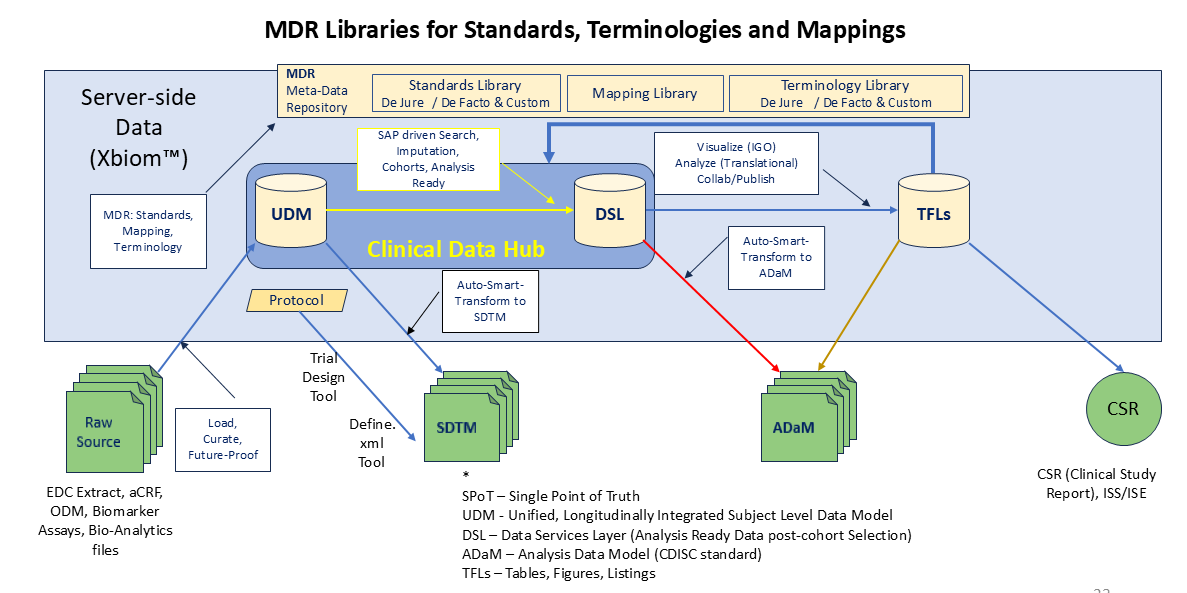
As-collected data from patients in the EDC and CRFs, and biomarker assay data from bio-banked bio-samples, is ingested through the virtual data room, curated using Xbiom dashboards, and auto-transformed by the Smart Transformer into a meta-model (UDM) repository. The Smart Transformer uses previously stored mappings from the MDR library to auto-generate SDTM with a selected IG and CT.
- ✓ The UDM serves the Smart Transformer and search query masks so biostatisticians can read the SAP, find analysis-ready cohorts, and generate the flags for the ADSL, BDS and OCCDS files of ADaM
- ✓ Analysis-ready data is layered onto the UDM to create a Data Services Layer (DSL); UDM and DSL together form the Clinical Data Hub (CDH) of the CDR
- ✓ The Smart Transformer prepares ADaM using stored MDR mappings or programmer scripts in R, Python or SAS on the SCE
- ✓ Generate TFLs directly from the DSL with onboard statistical tools and custom scripts, or from ADaM via traditional programming
- ✓ Included tools for Trial Design domains, TS.XPT and Define.XML
Every artifact your submission needs
Xbiom produces the standardized datasets, analysis outputs, and metadata required for a complete regulatory submission package.
SDTM datasets
Auto-generated from curated as-collected data with a selected IG and CT.
ADaM datasets
ADSL, BDS and OCCDS files prepared from the UDM and Data Services Layer.
SEND datasets
CDISC SDTM SEND datasets reconciled against the GLP Study Report.
TFLs
Tables, figures and listings from the DSL or from ADaM via traditional programming.
Define.XML
Submission metadata generated for both clinical and nonclinical datasets.
TS.XPT
Trial summary domain generated as part of the standardized package.
Trial design domains
TA, TE, TX and DM domains built with the included trial design tools.
Reconciliation report
SEND verified against the digital tabulation of the report’s summary tables.
The repository behind every clinical output
The UDM serves the Smart Transformer and search query masks with curated as-collected data, so authorized, qualified biostatisticians can read and interpret the SAP, find listings for analysis-ready cohorts, and generate the flags needed for ADaM.
Analysis-ready data is layered onto the UDM to create the Data Services Layer. Together, the UDM and DSL form the Clinical Data Hub of the Xbiom CDR, which manages the entire lifecycle of clinical data through the repository.
MDR libraries for standards, terminologies & mappings
The MDR holds the standards, controlled terminologies, and stored mappings the Smart Transformer reuses to auto-generate SDTM and ADaM, integrated with the CDR.
Ready to learn more?
PointCross Life Sciences Inc. delivers proven life sciences software solutions to support drug development through a suite of Nonclinical and Clinical offerings.
Stay up-to-date with personalized newsletters and schedule a call to explore how our life sciences software solutions drive efficiency in biopharma R&D.
Request more information
Fill in the form below and our team will be in touch.
