Data-driven decisions on ongoing clinical trials
For biotechs developing biologics on genomic or immuno-biomarkers, Xbiom™ integrates read-only EDC patient data and biomarker data from bio-samples in near real time, so your team can find key biomarkers and spot high responders early. That is bench-to-bedside translational medicine.
Find the biomarkers and responders while it matters
Closely monitoring an ongoing trial lets translational teams identify the key biomarkers that explain events and surface high positive or negative responders early, as soon as specialty assays on their bio-samples are available.
Explain the events
Identify the key biomarkers that explain what you are seeing in the trial, instead of waiting for a locked database to begin asking the question.
Spot responders early
Find high positive or negative responders as soon as their specialty assays return, so the next decision is informed by the latest bio-sample data.
Drive the next bio-sample
Identify which patients need bio-samples assayed, or new samples taken for specialty assays, to fill out analysis data sets or add an assay panel.
Translational medicine, in motion
EDC end-points and arriving biomarker data live in one longitudinal, patient-aligned model, so research and the clinic inform each other continuously.
Weeks-to-months, or within 24 hours
Interim monitoring is more complex than the traditional Clinical Operations workflow. Rather than converting EDC to SDTM and then ADaM on the SAP, we read EDC straight into a longitudinal Universal Data Model.
EDC → SDTM → ADaM on the SAP
Biometrics teams convert EDC data models to SDTM, then to ADaM ADSL, BDS and OCCDS files driven by the planned analysis plan, before interim questions can be answered.
EDC + biomarker → one UDM
Read-only EDC and biomarker data are curated into a single longitudinal, patient-aligned model on a sponsor-specific Xbiom™ base, ready for analytics directly, no intermediate conversions to wait on.
From read-only data to reproducible insight
A seven-step method that keeps the source untouched, integrates everything longitudinally, and turns analysis into shareable, self-updating objects.
Read & convert EDC into the UDM
Electronically read, curate and convert read-only EDC data into a Universal Data Model that is inherently longitudinal and patient-aligned, secured on an encrypted, sponsor-specific Xbiom™ Translational Insights base.
Bring biomarker data into the same model
Read, curate and convert bio-analytics and biomarker data, as received, into the same longitudinal, patient-aligned Universal Data Model.
Analysis-ready within 24 hours
Make this analysis-ready data available within 24 hours after frequent reading of the data updates.
Search and build stratified cohorts
Apply analytics models, scripts, search engines and APIs directly on the UDM to find cohorts meeting highly stratified criteria and analyze them against other cohorts on a single-window interface.
Capture insights as self-updating TFL objects
Save downloadable, shareable TFL objects as templates that auto-update with accretive data loads. They hold the data and the criteria for finding it through listings, tabulations and figures, with annotations, for a reproducible, evolving view of the patients being monitored.
Collaborate and publish
Search, find, collaborate and publish the TFLs into reports and posters.
Direct the next assays
Identify patients whose bio-samples need to be assayed, or whose new samples are needed for specialty assays, to fill out analysis data sets or run another assay panel.
See interim monitoring at work
From the study dashboard to individual-patient longitudinal views, stratified cohort building and statistical analysis saved as TFLs.
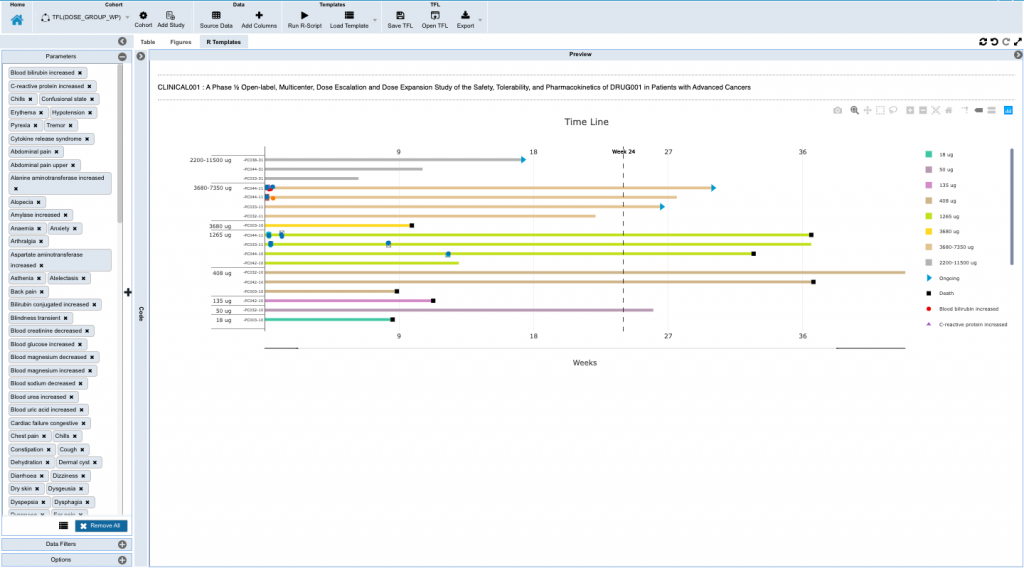
Overall study timeline of the ongoing study, with events laid out across the trial.
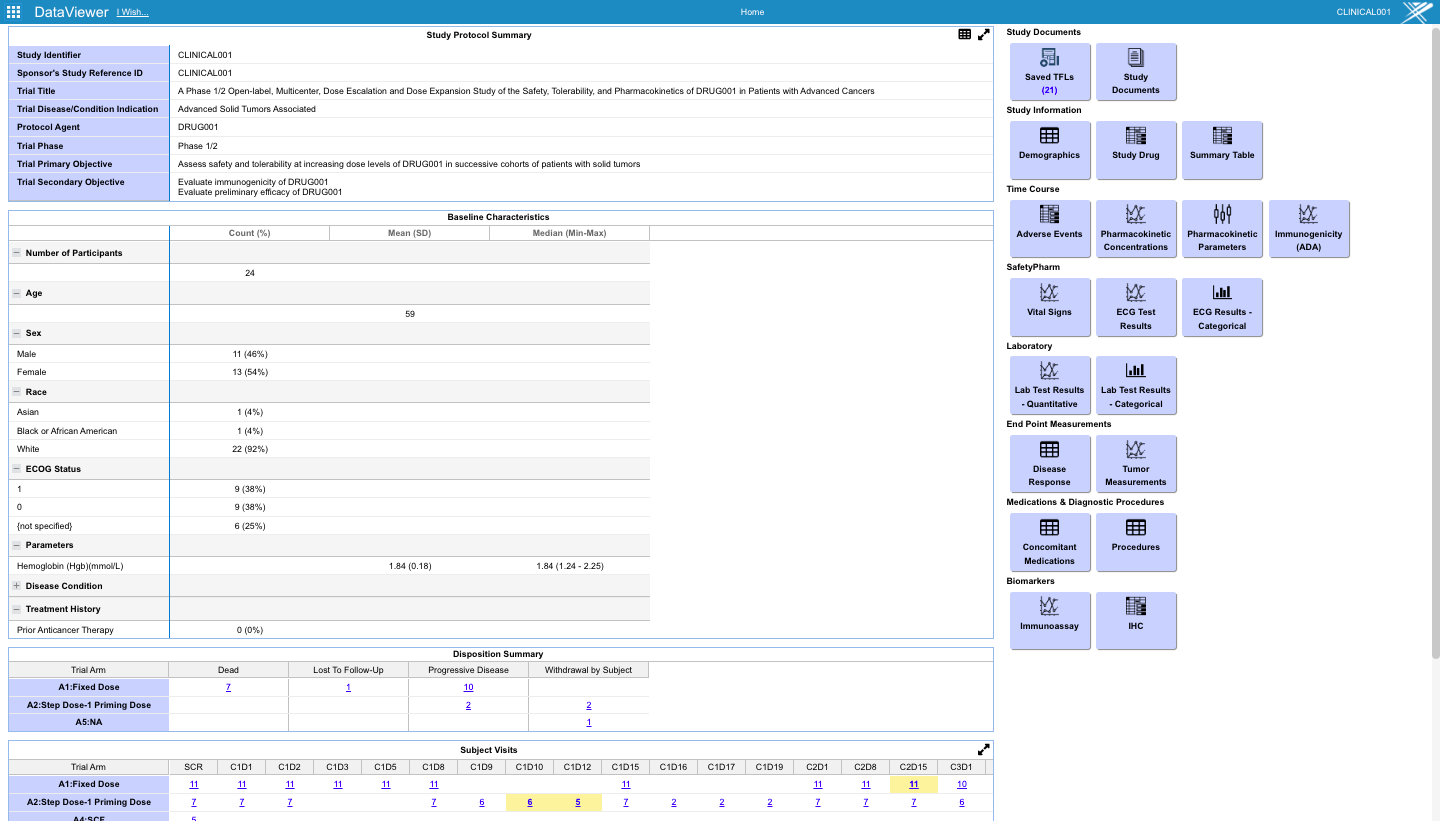
Preconfigured monitoring tables and charts, accessible from the study dashboard.
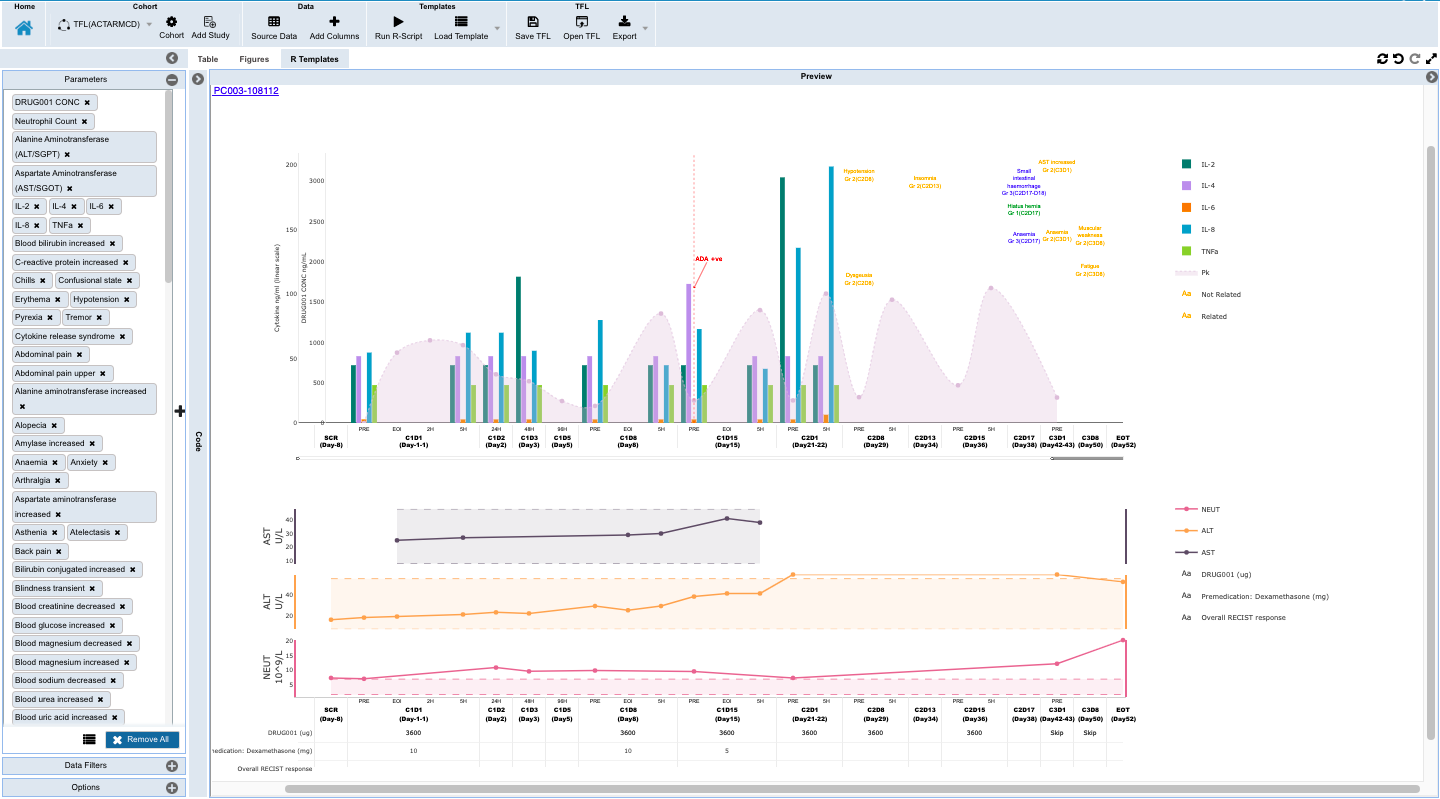
Individual patient safety and efficacy in one longitudinal view: dosing, events, lab, PK and biomarker.
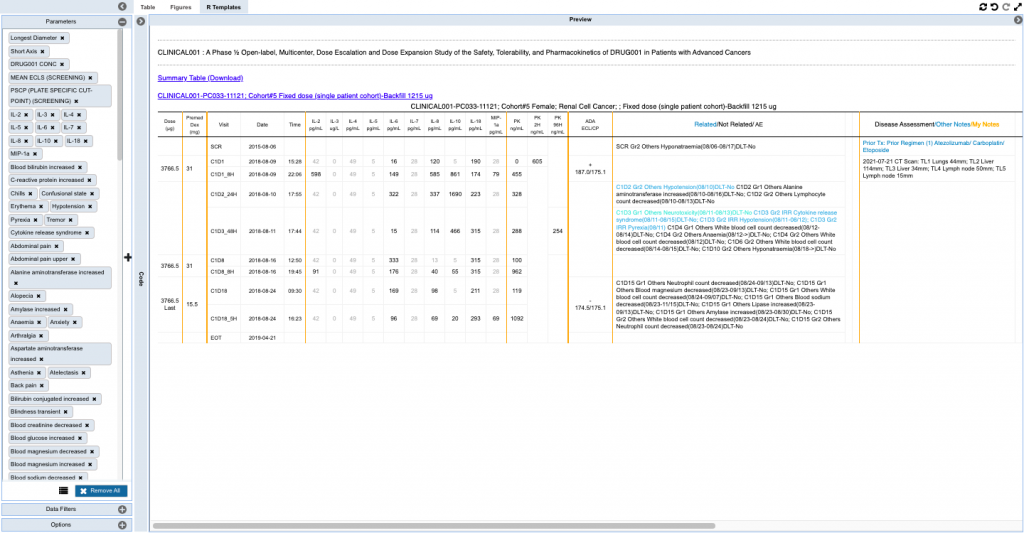
Scan tabulated data per subject, EDC + PK + biomarker integrated, with curated notes.

Stratified search and cohort building against highly specific criteria.

Customized statistical analysis of the cohort, saved as a TFL to keep private or share with the team.
Xbiom™ Insights plus a Data Concierge
Biotechs accelerate R&D through their clinical trials with Xbiom™ insights technologies under a monthly subscription, plus a companion Data Concierge service, also a fixed monthly subscription, giving access to a highly qualified virtual team.
Clinical interim monitoring, answered
What is clinical interim study monitoring on Xbiom™?+
How is this different from the traditional biometrics workflow?+
How quickly is the data analysis-ready?+
What is the Universal Data Model (UDM)?+
What are TFL objects?+
How is the service delivered?+
Monitor your trial as the data arrives
Bring EDC and biomarker data into one longitudinal model, build stratified cohorts on a single window, and capture insight as self-updating TFLs. See clinical interim monitoring on Xbiom™.
