The right bio-sample, sent for assay at the right moment
Specialty assays often run only once a patient meets stratified criteria, such as an exceptional responder or non-responder. Our sample recommendation engine applies those cohort criteria routinely across visits and tells you exactly which bio-samples to send to specialty labs, so no biomarker is missed.
Never miss a sample that should be assayed
Translational medicine calls for certain cohorts of subjects or patients to have their biomarkers measured. Knowing which samples to assay, and when, is a moving target as patients progress, and a missed window can mean a lost insight.
Criteria-driven, not calendar-driven
Specialty assays run when patients meet criteria, such as exceptional responders or non-responders. Those stratified criteria are applied routinely as patients go through their visits.
Knows what you have, and what is missing
The engine identifies which patients’ biomarkers have already been obtained and which are still missing, so the gap is always visible.
New or bio-banked samples
It directs new bio-samples or bio-banked samples to specialty labs for the assays that need to be performed, drawing on the right vial at the right time.
Assayed early, integrated back
Samples that should be assayed are identified as soon as possible, and the resultant data is integrated into the EDC end-points for analysis.
Three sources, one recommendation
Tracking manifests
All available shipment and chain-of-custody manifests, so the engine knows where every sample is and what is in each vial.
EDC data
The EDC, which usually records any bio-samples taken, including patient, visit, date/time and aliquot references.
Biomarker database
The biomarker results already obtained, used to tell exactly which patients’ biomarkers are present and which are missing.
What the engine returns
By reconciling all three against the stratified cohort criteria, the module makes sure no eligible sample is overlooked.
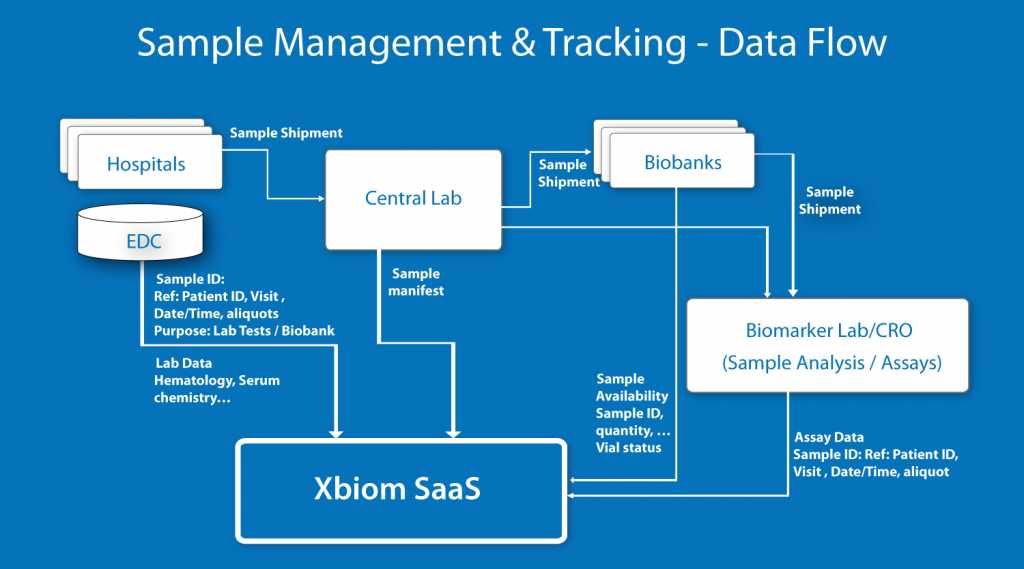
How samples and data flow into Xbiom
Physical samples move from site to lab to biobank to assay, while the identifiers, manifests, availability and results converge in Xbiom SaaS.
From cohort criteria to integrated result
Apply criteria
Stratified cohort criteria are applied routinely as patients go through their visits, flagging responders and non-responders.
Reconcile coverage
Manifests, EDC and the biomarker database are reconciled to see which biomarkers are obtained and which are missing.
Recommend samples
The engine recommends which new or bio-banked samples to send to specialty labs for the assays that should be performed.
Integrate results
Resultant assay data is integrated into the EDC end-points, closing the loop for analysis.
Biosample tracking, built into translational monitoring
The sample recommendation engine runs on Xbiom™, alongside interim clinical monitoring and biomarker integration, so the samples you assay and the data you analyze stay in one connected environment, supported by our Data Concierge team.
Biosample tracking, answered
What does the biosample tracking module do?+
When are specialty assays triggered?+
What data does the recommendation engine use?+
Does it work with bio-banked samples?+
How do the assay results get back into the study data?+
Stop missing the samples that matter most
Apply your cohort criteria continuously, reconcile manifests, EDC and biomarker data, and send the right bio-samples for specialty assays on time. See biosample tracking on Xbiom™.
